


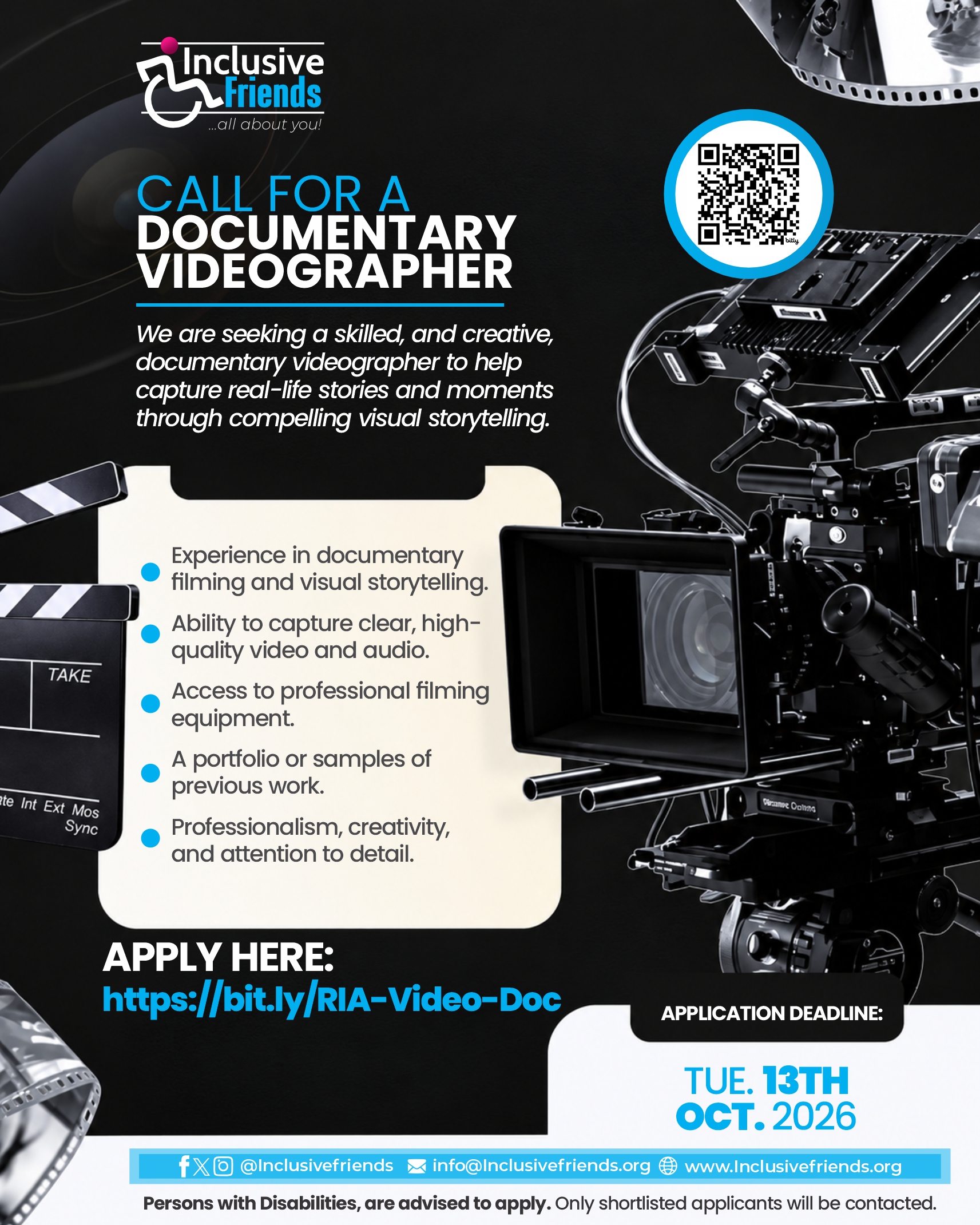
Video Documentary Consultant
Location: Abuja FCT
Closing Date: October 13, 2026
Background
Rights in Action (RiA) is a CBM Global advocacy project led by Organisations of Persons with Disabilities (OPDs) and funded by Finland’s Ministry of Foreign Affairs. Running from February 2025 to December 2026 in Nigeria and Zimbabwe, the project aims to address intersectional discrimination and human rights violations faced by persons with disabilities, particularly those from underrepresented groups, and promote their equal participation in political and public life.
RiA supports underrepresented OPDs, especially those representing psychosocial, Deaf, and intellectual disability groups, to lead advocacy efforts that tackle discriminatory laws, norms, customs, and practices. These efforts are aligned with the UN Convention on the Rights of Persons with Disabilities (CRPD), the African Disability Protocol (ADP), and the Sustainable Development Goals (SDGs).
The project is implemented through partners at the national, regional, and global levels. In Nigeria, it is delivered by the Inclusive Friends Association (IFA) and the Joint National Association of Persons with Disabilities (JONAPWD), which provide institutional and advocacy capacity-strengthening support. Advocacy activities are led by five OPDs: the Down Syndrome Foundation (DSFN), Riaby Maria Autism Foundation (RBM), The Engraced Ones, the National Association of the Deaf(NNAD), and Yamban Kabati Africa Foundation(Y-KAF).
Rationale & Aim
As the Rights in Action (RiA) project reaches its endline in December 2026, capturing its impact in Nigeria is vital. The documentary will serve as a powerful accountability, advocacy, and storytelling tool to showcase how capacity-strengthening interventions transformed the landscape for persons with disabilities, particularly underrepresented groups (psychosocial, Deaf, and intellectual disability groups). The goal is to capture photographs and videos telling human-angled stories and appeal to the humane side of different targets the video is meant for while advocating and showing the successes and challenges encountered.
This approach will provide real data and case studies, and will highlight recommendations to the different targets that the videos are meant for.
The Core Need: To document the journey, challenges, and milestones achieved by partners IFA, JONAPWD and OPDs (DSFN, RBM, De Engraced Ones, NNAD, and Y-KAF) on the RiA project
The Strategic Value: Providing empirical visual evidence and human-interest narratives for Finland’s Ministry of Foreign Affairs, CBM Global, and national stakeholders to validate project outcomes for possible scale-up
The video is meant for, but not limited to, the targets listed below:
- CBMG, Partners and Implementers
- Donor and Funding Agencies
- Stakeholders
- Public Awareness
Specific requirements
Interview Questions and Objectives:
The questions asked during the interviews will be designed to gather insights into several key aspects of the project:
- Objective of the project: Understanding the overarching goals and objectives of the project alongside the different components
- Challenges: Identifying the obstacles encountered during the implementation of the project and approaches used to tackle them.
- Success recorded: Highlighting the achievements and positive outcomes of the project.
- Recommendations: Gathering suggestions, recommendations, and learning for improving future initiatives for scale-up.
Types of Photos/Videos Required for Interview Segments
Interviews should be visually compelling, professionally framed (typically medium-close-ups with soft, out-of-focus backgrounds), and capture both emotional depth and technical insights:
- Project Leadership & Implementing Partners:
- Key representatives from CBM Global, JONAPWD and IFA discussing institutional growth, systemic barriers tackled, and the overall trajectory of the RiA project from 2025 to 2026.
- OPD & Self-advocates:
- Spokespersons and leaders from the five implementing OPDs (DSFN, RBM, The Engraced Ones, NNAD, and Y-KAF) sharing success stories, grassroots mobilisation wins, and advocacy lessons learned.
- Advocates from Deaf, intellectual, and psychosocial disability communities sharing personal transformation stories, how their leadership capacity grew, and what equal participation in political and public life means to them.
- External Stakeholders (Government stakeholders, Local traditional rulers & Mentors):
- Government officials, coalition partners, or civil society allies reflecting on the impact of OPD-led advocacy and the value of Finland’s Ministry of Foreign Affairs & CBM Global support.
- Mentors reflecting on how working with under-represented OPDs has improved their understanding of disability inclusion, strategies adapted for mentoring and recommendations for future initiatives
Types of Photos/Videos Required for B-Rolls
To visually anchor the documentary and reflect the project's scope, the B-roll library should capture authentic, high-impact moments across four main categories:
- Capacity-Strengthening & Institutional Activities:
- Workshops, training sessions, and advocacy capacity-strengthening meetings facilitated by IFA & JONAPWD.
- OPD members (DSFN, RBM, De Engraced Ones, NNAD, Y-KAF) engaging in strategy planning, resource mapping, and collaborative sessions.
- Community Advocacy & Public Engagement:
- Grassroots campaigns, media campaigns, community awareness and stakeholder dialogues addressing the need for implementation of policies and discriminatory norms and practices.
- OPD leaders engaging with local authorities, policymakers, or community elders to advocate for political and public inclusion.
- Daily Life & Inclusion in Action:
- Candid, dignified shots of persons with disabilities, particularly from underrepresented groups (Deaf, intellectual, and psychosocial disabilities) participating actively in community life, workplaces, or social gatherings.
- The use of inclusive communication tools, such as sign language interpreters actively working during meetings or public forums.
- Environmental & Institutional Context:
- Landmark locations in Nigeria (e.g., meeting halls, institutional offices, community spaces) where project activities took place.
- Close-up insert shots of project reports, policy documents, training manuals, and branded advocacy materials tied to the CRPD, ADP, and SDGs.
Output Deliverables
- The consultant will be expected to produce a script for the video documentary. The script will be reviewed and approved by the RiA project team
- The Primary Documentary: A 7 to 10-minute comprehensive endline documentary (Full HD/4K) complete with professional voiceover, subtitling/closed captions for accessibility, and international sign language interpretation.
- 2 final cut versions of video documentary 4 - 6 minutes in length focused on the 2 project objective
- Social Media Advocacy Cuts: Three standalone 60 to 90 seconds teaser videos optimised for platforms like X, LinkedIn, and Instagram, highlighting specific cluster transformations and key project outcomes.
- Archival B-Roll & Photo Library: A curated, high-resolution media asset library containing raw B-roll footage of project activities, advocacy meetings, and community engagements, alongside at least 50 professionally edited photographs and all raw photos.
- Accessible Media Package: Fully formatted subtitle files (.srt) and audio-described versions to ensure the final deliverables are fully inclusive and compliant with disability accessibility standards.
Videographer Profile & Specifications
To successfully deliver the RiA endline documentary, the engagement requires a professional documentary videographer or production crew with specialised competencies in human rights and disability storytelling, inclusive media production, and deep familiarity with the Nigerian socio-political landscape.
Key Requirements & Qualifications
- Demonstrated Documentary Portfolio: Proven track record in producing high-impact, narrative-driven institutional or development sector documentaries (ideally for international NGOs, UN bodies, or foreign missions).
- Expertise in Disability-Inclusive Media: Demonstrated understanding of ethical, respectful, and dignified framing of persons with disabilities, avoiding pity or charity-based narratives and instead focusing on agency, leadership, and ownership
- Strict Adherence to Safeguarding & Confidentiality: Proven understanding of communication safeguarding principles, particularly regarding vulnerable groups such as persons with disabilities and children.
- Informed Consent Protocols: Experience conducting rights-based informed consent processes. This includes ensuring participants, especially those from underrepresented groups like psychosocial, Deaf, and intellectual disability communities, fully understand where, how, and by whom their footage will be used, with the absolute right to withdraw consent at any stage.
- Technical Accessibility Competence: Experience working alongside Sign Language interpreters, integrating closed-caption workflows, and ensuring audio-visual products comply with universal accessibility standards.
- Local Context & Access: Established operational capacity in Nigeria (specifically Abuja and target project implementation areas), with strong cultural awareness and the interpersonal skills needed to engage comfortably with grassroots Organisations of Persons with Disabilities (OPDs), including underrepresented groups (Deaf, intellectual, and psychosocial disability communities).
Technical & Equipment Requirements
- Cinematic Production Gear: 4K-capable digital cinema cameras with wide dynamic range sensors, professional-grade multi-channel audio recording gear (wireless lavalier microphones, shotgun mics, and clean off-board audio backup), and versatile lighting kits for variable field conditions.
- Post-Production Proficiency: In-house capability for colour grading, professional audio mastering, multilingual subtitle integration (.srt generation), and embedding International Sign Language inset frames.
SUBMISSION REQUIREMENTS
Interested consultants should submit the following to recruitment@inclusivefriends.org by October 13, 2026, with the subject "Application – Video Documentary Consultant, Rights in Action."
- Cover Letter / Expression of Interest – brief explanation of their interest and suitability.
- CV/Profile – highlighting relevant documentary, filmmaking, videography and storytelling experience.
- Technical Proposal – proposed approach/methodology, production process, timeline and understanding of the assignment.
- Financial Proposal/Quotation – detailed cost for the assignment.
- Portfolio/Samples of Previous Work – preferably links to 2–3 relevant documentary/video productions, particularly human-interest, development, advocacy or social-impact work.
- Availability – confirmation that they are available during the assignment period.
- Team Profile, if applying as a production company – including key personnel and their roles.
IFA Inclusion Statement: IFA is committed to promoting the full inclusion and participation of women and persons with disabilities, without discrimination. All staff, volunteers, interns, consultants, vendors and beneficiaries shall uphold this principle regardless of belief, gender, background, disability type and work to ensure dignity, respect, and equal opportunity for all.
Zero-tolerance for Sexual Exploitation, Abuse (SEA) Statement: IFA upholds a zero-tolerance policy for sexual exploitation, abuse (SEA), and child abuse in any form. Any consultant, beneficiary, vendor, contractor, or other party associated with this agreement found to be in violation of this policy will result in the immediate termination of this agreement. Such actions may also lead to further legal or regulatory actions in accordance with applicable laws